Loading

Tree Felling vs Tree Pruning: Which Does Your Tree Need?

  • Home
  • Blogs
  • Tree Felling vs Tree Pruning: Which Does Your Tree Need?
If a tree has become too large, is causing concern or appears unhealthy, it can be difficult to know whether it needs to be pruned or completely removed.
 
Tree pruning and tree felling are very different approaches. Pruning retains the tree and selectively removes branches, while tree felling removes the entire tree. Wherever possible, appropriate tree management may allow a healthy tree to remain, but there are circumstances where removal is the safer or more practical option.
 
At Oxleas Tree Care, we provide professional tree pruning, tree felling and tree care services across South East London and Kent. In this guide, we look at the differences between tree felling and pruning and how to determine which may be appropriate for your tree.

What Is Tree Pruning?

Tree pruning involves selectively removing particular branches from a tree rather than removing the tree itself.
 
Professional pruning can be carried out for several reasons, including improving the tree’s structure, removing dead or damaged branches, managing its size and spread, increasing clearance around buildings or pathways, and maintaining the tree’s overall condition.
 
The objective isn’t simply to cut branches back. Good tree pruning considers the species, age, condition and natural form of the tree before deciding what should be removed.

What Are the Different Types of Tree Pruning?

The type of pruning required depends on what you are trying to achieve.
 
Crown Reduction
Crown reduction decreases the overall height or spread of the tree’s crown while maintaining an appropriate shape.
It can be useful where a tree has become too large for its surroundings or where additional clearance is required.
 
Crown Thinning
Crown thinning selectively removes branches throughout the crown to reduce its density without substantially changing the tree’s overall size or shape.
 
Crown Lifting
Crown lifting involves removing or shortening lower branches to provide additional clearance beneath the tree.
This may be appropriate where branches are interfering with pathways, driveways, roads or access.
 
Deadwood Removal
Dead, damaged or dying branches can be selectively removed without unnecessarily pruning healthy sections of the tree.
The appropriate technique depends on the individual tree and the reason for carrying out the work.

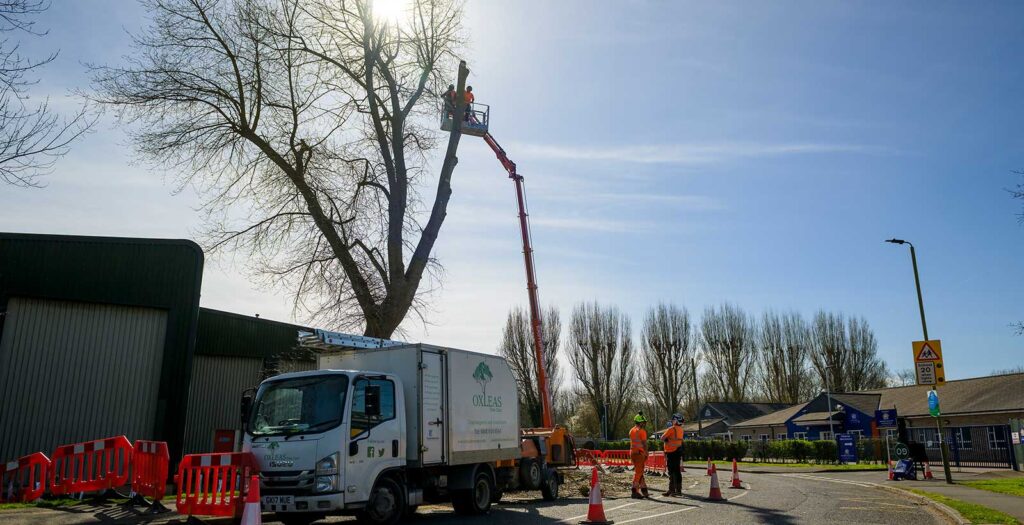
What Is Tree Felling?

Tree felling means completely removing a tree.
 
Where there is sufficient space and it can be done safely, a tree may sometimes be felled from ground level. In residential gardens and built-up areas, however, there is often not enough room to allow the whole tree to fall safely.
 
In these situations, the tree may need to be dismantled in controlled sections. A tree surgeon climbs the tree or uses suitable access equipment and progressively removes branches and sections of the trunk.
 
Ropes and specialist rigging equipment may be used to lower sections safely where there are buildings, fences, sheds, roads or other obstacles beneath the tree.

When Is Tree Pruning the Better Option?

If the tree is healthy and the underlying problem can be addressed without removing it, pruning may be the more appropriate solution.
 
For example, pruning may be considered where branches are growing too close to a property, the crown has become excessively large or dense, dead or damaged branches need removing, lower branches are obstructing access, or the tree requires ongoing management.
 
The important question is not simply “Can we make this tree smaller?”, but rather “What work can be carried out while maintaining an appropriate structure for the tree?”
 
Excessive or inappropriate pruning can cause lasting damage, so the amount and type of work should be carefully considered.

When Might a Tree Need to Be Felled?

There are situations where pruning alone may not adequately address the problem.
 
Tree removal may need to be considered if a tree is dead, severely diseased, structurally compromised or presents an unacceptable risk that cannot reasonably be managed through pruning.
 
Removal may also be appropriate where a tree has suffered significant storm damage, is causing a problem that cannot be addressed through suitable pruning, or needs to be removed as part of an approved development or landscape plan.
 
However, a tree shouldn’t automatically be removed simply because it is large or inconvenient. A professional assessment can help determine whether it can reasonably be retained and managed.

Does a Leaning Tree Need to Be Cut Down?

Not necessarily.
 
Some trees naturally grow at an angle and can remain stable for many years. A lean becomes more concerning when it has developed recently, particularly following high winds or ground movement, or when accompanied by signs such as disturbed soil, lifting roots, cracks or structural damage.
 
If a tree has suddenly started leaning, it should be professionally assessed rather than assuming that pruning will solve the problem.

Does a Diseased Tree Always Need to Be Felled?

No.
 
The presence of disease or decay doesn’t automatically mean that a tree needs to be removed.
 
The decision depends on factors including the type and extent of the problem, the parts of the tree affected, its structural condition and what would be at risk if part of the tree failed.
 
Some trees can continue to be safely managed, while others may require removal.
 
This is where a professional tree assessment or tree survey can be particularly useful.

What If the Tree Is Too Close to My House?

A tree growing close to a house does not automatically need to be felled.
 
The species, size, condition and position of the tree all need to be considered, along with the actual problem it is causing.
 
If branches are touching the building or obstructing windows, for example, appropriate pruning may provide sufficient clearance.
 
If you are concerned about roots, structural damage or the stability of a large tree close to your property, seek professional advice before deciding on removal.

What Happens to the Stump After Tree Felling?

Felling a tree does not automatically remove the stump.
 
Once the tree has been removed, the remaining stump can either be left in place or removed using stump grinding.
 
A stump grinder mechanically grinds the stump down below ground level. This may be useful where you want to re-landscape the area, remove a trip hazard or simply don’t want the old stump remaining in the garden.
 
If you want the stump removed, discuss this when arranging the tree felling so it can be included within the proposed work.

Do I Need Permission to Fell or Prune a Tree?

Potentially.
 
Trees can be protected by a Tree Preservation Order (TPO), and additional controls apply to qualifying trees within conservation areas.
 
A TPO can prohibit unauthorised cutting down, topping, lopping, uprooting, wilful damage or destruction of a protected tree. This means that protection can apply to pruning as well as complete removal.
 
Before substantial tree work begins, it is therefore important to establish whether the tree is protected.
 
Internal link: Do I Need Permission to Cut Down a Tree? A Guide to TPOs and Conservation Areas.

Tree Felling or Tree Pruning: How Do I Decide?

The decision should be based on the condition of the tree and what you are trying to achieve.
 
A useful starting point is:
Situation Possible Approach
Healthy tree has become too large Pruning / crown reduction
Lower branches obstruct access Crown lifting
Tree contains dead branches Deadwood removal / pruning
Crown is excessively dense Appropriate crown management
Tree is severely structurally compromised Assessment and possible felling
Tree is dead and presents a risk Possible tree felling
Tree has suffered major storm damage Professional assessment
Tree is simply larger than desired Assess pruning before considering removal
These are general examples rather than a diagnosis. The individual tree needs to be assessed before deciding on the appropriate work.

Why Professional Assessment Matters

It isn’t always obvious from ground level whether a tree needs pruning or removal.
 
A professional tree surgeon can assess its condition, structure, surroundings and the reason for the proposed work before recommending an appropriate course of action.
 
This can prevent unnecessary removal while also identifying situations where retaining a badly compromised tree could create an avoidable risk.

Professional Tree Felling & Tree Pruning Across South East London and Kent

If you’re unsure whether your tree needs pruning or removal, Oxleas Tree Care can help.
 
 
Our team can assess the tree, discuss what you’re trying to achieve and recommend the most appropriate approach.
 

Frequently Asked Questions

Is it better to prune a tree or cut it down?

If a healthy tree can be appropriately managed through pruning, complete removal may not be necessary. Felling may be considered where the tree is dead, severely compromised or cannot reasonably be retained.

In some circumstances, yes. Crown reduction can reduce the height or spread of an appropriate tree, although the amount that can safely be removed depends on the species, condition and structure of the tree.

Not automatically, but a dead tree in a location where falling branches or structural failure could cause harm should be professionally assessed.

Sometimes pruning can remove damaged or problematic branches and help manage a tree effectively. However, pruning cannot correct every structural or health problem.

You may still require consent. A Tree Preservation Order can cover pruning activities such as topping and lopping as well as felling.

Not necessarily. Stump grinding is usually a separate operation, so ask for it to be included if you want the stump removed.

Accredited by

Acclaim
ARB Approved Contractor
SSIP
Construction Line Gold Member
TrustMark

Trusted by Leading Businesses and Organisations